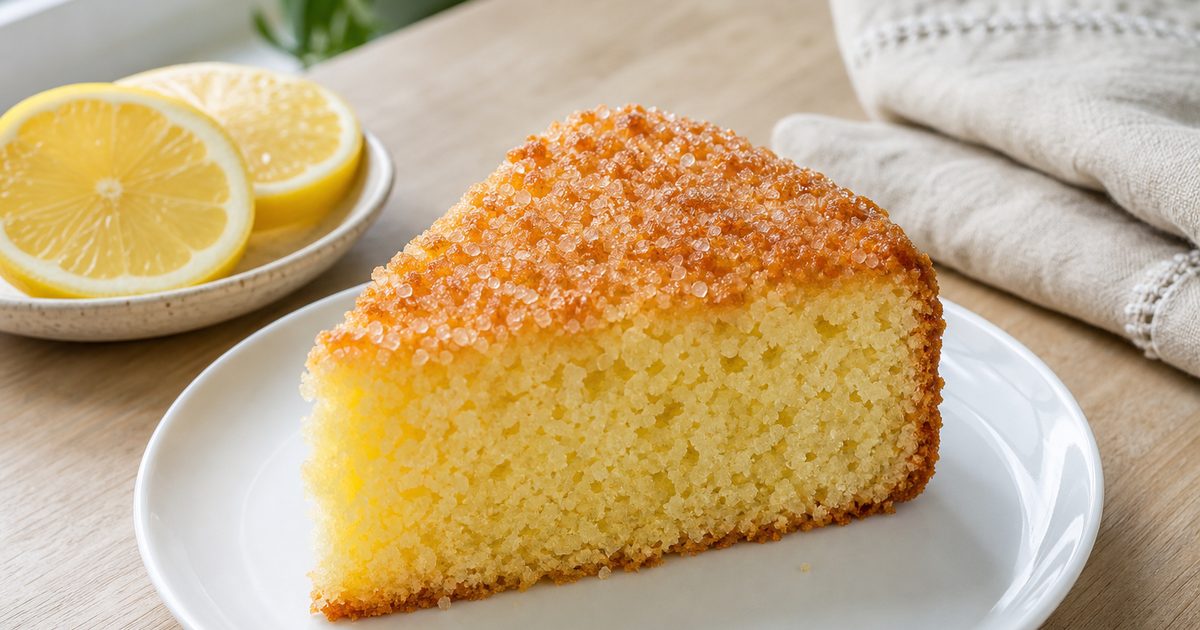
The first slice tells you whether the topping worked: a little crackle under the knife, then a soft crumb flecked with lemon zest. Lemon crunch cake gets that contrast without frosting, a glaze, or a separate crumble mixture. A layer of granulated sugar goes over the batter just before baking.
Underneath sits a buttery cake made with buttermilk and the zest of one large lemon. The flavor is gently citrusy rather than sharply tart, since the recipe uses zest, not juice. Serve a slice plain so the sugar crust gets its moment.
Lemon crunch cake at a glance
- Prep time: 15-20 minutes
- Bake time: 30-35 minutes
- Total time: 45-55 minutes, plus cooling
- Oven temperature: 350°F (175°C)
- Yield: One 9-inch cake, cut into 8-12 slices
- Pan: A 9-inch (23 cm) round springform pan
The preparation estimate assumes your butter has already softened and your eggs and buttermilk have reached room temperature. Set them out only as long as needed, keeping their total time outside refrigeration under two hours.
Ingredients for lemon crunch cake
Measure the two portions of sugar separately. The larger amount goes into the batter; the smaller amount stays on top.
- 1/2 cup (113 g) unsalted butter, softened to room temperature
- 1 cup (200 g) granulated sugar, for the batter
- Zest of 1 large lemon
- 2 large eggs, at room temperature
- 1/2 cup (120 ml) buttermilk, at room temperature
- 1 1/2 cups (180 g) all-purpose flour
- 1 teaspoon baking powder
- 1/2 teaspoon baking soda
- 1/4 teaspoon salt
- 1/4 cup (50 g) granulated sugar, for the topping
You will also need an electric mixer, two mixing bowls, a spatula, a wire rack, and a toothpick or wooden skewer.
Allergen note: This recipe contains milk, eggs, and wheat/gluten. It does not call for nuts or soy, but check ingredient labels for cross-contact warnings when cooking for someone with allergies.
Small details that make a difference
Softened butter should give slightly when pressed, without looking oily or melted. Butter in that state can trap air as you beat it with sugar, helping the cake rise.
Wash and dry the lemon before zesting. Grate only the yellow outer skin; the white pith underneath tastes bitter. Adding extra pith will not give you a stronger, fresher lemon flavor.
Buttermilk supplies acidity as well as moisture. That acidity works with the baking soda, so it has a practical role beyond flavor.
For a tender lemon crunch cake, measure the flour carefully. Spoon it into your measuring cup and level the surface rather than scooping directly from the bag. Use the listed gram weight if you have a kitchen scale.
How to make lemon crunch cake
1. Prepare the oven and pan
Heat the oven to 350°F (175°C), positioning a rack near the center.
Grease and flour the springform pan, tapping out excess flour. Alternatively, line the base with parchment and grease the sides. Check that the base sits securely before adding any batter.
Have all your ingredients measured before you start mixing. Once the flour goes in, you should need only a brief mix before filling the pan.
2. Cream the butter and sugar
Put the softened butter and 1 cup (200 g) sugar into a large mixing bowl. Beat with an electric mixer for about 2 minutes, until the mixture looks lighter and fluffier.
Stop to scrape the bottom and sides of the bowl. A thick band of unmixed butter around the edge can leave the batter uneven.
The sugar may still feel slightly grainy. You do not need to beat until every crystal dissolves.
3. Add the wet ingredients
Beat in the eggs one at a time, incorporating each before adding the next. Scrape the bowl again, then mix in the lemon zest and buttermilk.
The mixture may look slightly curdled after you add the buttermilk. That does not necessarily mean anything has gone wrong; continue with the dry ingredients rather than beating it longer.
Do not taste the raw batter. Uncooked eggs and flour can carry harmful bacteria. Wash your hands and clean utensils or surfaces that touch raw egg.
4. Mix in the dry ingredients
In your second bowl, whisk together the flour, baking powder, baking soda, and salt.
Gradually add the dry mixture to the wet ingredients, using the mixer on low speed. Stop when no dry flour remains. Scrape the bottom with a spatula to check for hidden pockets.
Extended mixing develops gluten and can make the crumb tougher. Once the batter comes together, move straight to the pan.
5. Add the sugar topping
Scrape the batter into the prepared pan and spread it into an even layer.
Sprinkle the remaining 1/4 cup (50 g) sugar evenly over the surface, reaching toward the edges. Leave it on top rather than folding it into the batter.
An even coating gives lemon crunch cake its crisp surface. Avoid leaving a mound of sugar in the center while the edges stay bare.
6. Bake and cool
Bake for 30-35 minutes. Start checking at 30 minutes: the top should look golden, and a toothpick inserted into the center should come out without wet batter.
If the toothpick shows uncooked batter, continue baking and check again. Color alone cannot tell you whether the middle has finished cooking.
Set the pan on a wire rack and let the cake cool in the pan before releasing the springform ring. Cooling also lets the crumb firm up, making cleaner slices easier.
Substitutions and serving ideas
Whole milk can replace the buttermilk in the same amount: 1/2 cup (120 ml). Expect a different result, though. Milk lacks buttermilk’s acidity, which affects how the baking soda behaves and can change the flavor and texture.
For the most predictable bake, use buttermilk as written.
This lemon crunch cake needs no frosting. Serve it plain with tea or coffee, or place fresh blueberries or raspberries alongside each slice. Serving berries separately preserves the batter’s original moisture balance and keeps the topping uncovered.
Avoid pouring a glaze over the cake if the crunch is what you enjoy most. Added moisture softens that sugar layer.
Storage and serving leftovers
Let the cake cool completely before covering it. Trapped steam makes the surface damp and softens the crust.
Store it in an airtight container at room temperature for up to 2 days, in a cool spot away from sunlight. For longer storage, refrigerate for up to 5 days. Expect the topping to lose some crispness as the cake sits.
Freeze individual slices or the whole cake in an airtight freezer-safe container for 1-2 months. Thaw covered in the refrigerator, then bring slices to room temperature before serving.
Reheating is optional. Room-temperature slices keep their texture better than microwaved ones, which can soften the sugar topping.
Frequently asked questions
What makes the topping on lemon crunch cake crunchy?
The granulated sugar sprinkled over the raw batter forms a crisp crust during baking. Keep the topping sugar separate and spread it evenly before the pan goes into the oven.
Can I use lemon juice instead of zest?
Lemon juice is not a direct replacement here. Zest provides aromatic citrus oils without adding liquid. Swapping in juice changes the batter’s moisture and acidity, so stick with zest for this recipe.
Why did my cake turn out dense?
Too much flour, insufficient creaming, or overmixing after adding flour can contribute. Check your measurements, start with softened butter, and stop mixing once the dry ingredients disappear.
Can I make this recipe without eggs?
This version relies on eggs for structure. An egg-free substitution has not been established here, so a tested egg-free cake recipe offers a more dependable result.
Can I make lemon crunch cake ahead?
Yes, though the topping has the best texture on the day of baking. For next-day serving, cool the cake completely before storing it airtight. Leave it unfrosted to protect the crust.