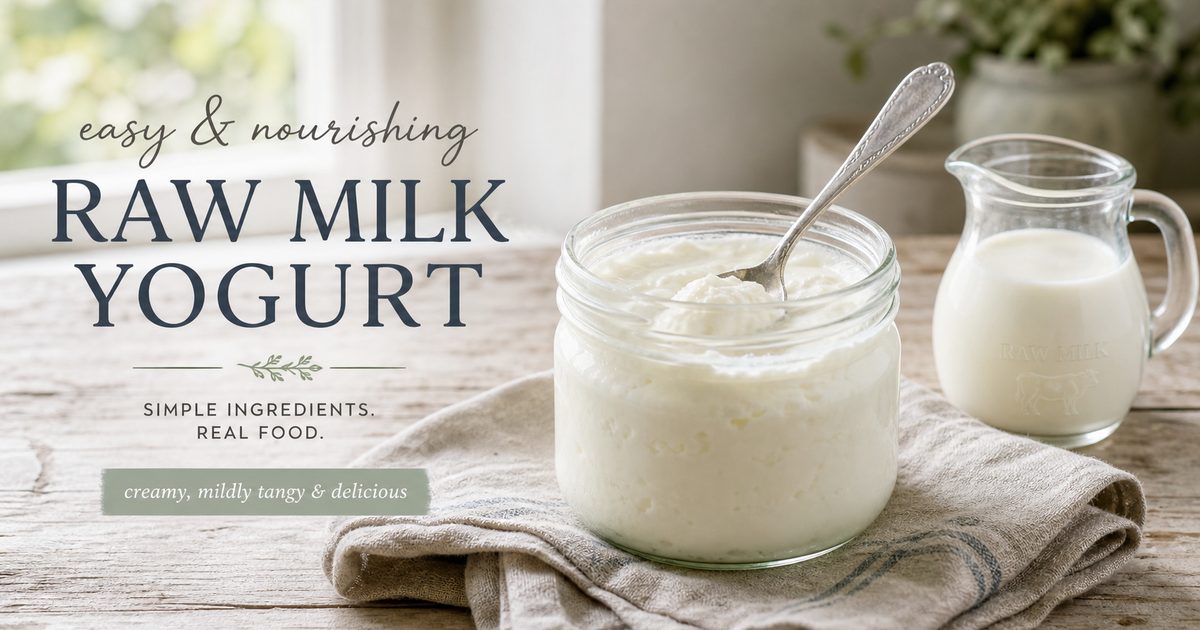
There’s a point where store-bought yogurt just doesn’t hit the same. If you want a batch with a clean tang and a soft, spoonable set, this raw milk yogurt is a simple kitchen project that mostly asks for patience and steady heat. You warm the milk gently, stir in a live starter, and hold the mixture at a cozy temperature until the raw milk yogurt thickens. That’s the whole idea.
This recipe makes 1 gallon, so it’s handy if you like to fill several jars at once and keep raw milk yogurt in the fridge for the week.
What you need for raw milk yogurt
Prep time: 5 to 10 minutes
Incubation time: 8 to 24 hours
Chilling time: at least 4 hours
Total time: about 12 to 28 hours
Yield: 1 gallon (3.8 liters)
Ingredients
- 1 gallon (3.8 liters) raw milk
- 1 cup (240 ml) plain full-fat yogurt with live active cultures, store-bought or from a previous batch
- Optional: 16 teaspoons unflavored gelatin, about 1/3 cup, for thicker yogurt
This recipe contains dairy.
Before making raw milk yogurt
The biggest factor in a raw milk yogurt recipe is temperature. During incubation, keep the milk between 100 and 110°F (38 to 43°C). If the temperature drops too low, the yogurt may stay thin. If it gets too warm, the culture can weaken and the flavor can turn sharper than you want.
Fresh milk matters too. Use raw milk that smells clean and sweet, and keep it cold until you start.
There’s also an important safety note here. Raw milk can carry harmful bacteria, including Campylobacter, E. coli, Salmonella, and Listeria. Fermentation changes the milk, but it does not make raw milk risk-free. Children, pregnant women, older adults, and anyone with a weakened immune system should avoid raw milk products unless the milk has been pasteurized first.
If you want a safer option and a thicker final texture, some cooks heat the milk to 180°F (82°C), hold it there for 30 minutes, then cool it to 110°F (43°C) before adding the starter. That makes yogurt, but it is no longer raw milk yogurt.
Ingredients that make raw milk yogurt work
Raw milk is the whole base of this recipe, so its quality shows in the final jar. Good milk gives the yogurt a fresh flavor and a gentle tang.
The starter yogurt does the actual fermenting. Choose a plain, full-fat yogurt labeled live active cultures. Avoid flavored yogurt or anything with thickeners if you can. A clean starter usually gives you a cleaner set.
Gelatin is optional, but it can help if you want thicker raw milk yogurt right in the jar. Since raw milk has not been heated to denature the proteins, the texture often stays looser than yogurt made with heated milk. Gelatin helps bridge that gap.
How to make raw milk yogurt
-
Warm the milk gently.
Pour the raw milk into a large pot or double boiler. Warm it slowly to 110°F (43°C). Use an instant-read thermometer and check often. Don’t guess here. -
Add the gelatin, if using.
Put the gelatin in 1/4 cup (60 ml) of the raw milk and let it soften briefly. Whisk it into the warming milk until fully dissolved. -
Temper the starter.
In a bowl, whisk the 1 cup yogurt starter with a few tablespoons of the warm milk until smooth. This keeps the starter from clumping when you add it to the pot. -
Combine.
Pour the starter mixture into the warm milk and stir gently until evenly mixed. -
Fill the jars.
Pour the milk into clean jars, such as quart-size mason jars, or into the container that fits your yogurt maker. -
Incubate.
Keep the jars at 100 to 110°F (38 to 43°C) for 8 to 24 hours. A yogurt maker works well. You can also use a dehydrator, a proofing box, an Instant Pot on a yogurt or sous vide setting, or an oven with the light on if it holds a steady temperature. -
Chill to set.
Move the jars to the refrigerator and chill for at least 4 hours before serving. The texture improves as it cools.
How to tell when raw milk yogurt is ready
Look at the texture first. The raw milk yogurt should look thickened and softly set. It may pull slightly from the sides of the jar when you tilt it.
Don’t expect a firm supermarket-style set unless you used gelatin or plan to strain it. A homemade batch often looks more delicate. That’s normal.
Taste matters too. Start checking on the earlier side if your kitchen setup runs warm. At 8 hours, the yogurt may taste mild. At 16 to 24 hours, it usually tastes tangier.
Tips for thicker raw milk yogurt
If your raw milk yogurt turns out thin, that doesn’t always mean something went wrong. Raw milk yogurt is often naturally looser.
Here are the fixes that actually help:
- Use the optional gelatin if you want a firmer spoonable set.
- Strain the finished yogurt through butter muslin or a clean cheesecloth-lined sieve to remove some whey. This gives you a thicker, Greek-style yogurt.
- Keep the incubation temperature steady. Fluctuating heat often leads to uneven texture.
- Chill it fully before judging the texture. Warm yogurt always seems thinner.
If your batch separates into curds and whey, the incubation temperature may have run too high, or the yogurt may have cultured too long.
Easy variations for raw milk yogurt
This is a good base recipe, so you can adjust the finish after the yogurt chills.
- Stir in honey or maple syrup just before serving.
- Top with fresh fruit or granola.
- Strain it for a thicker homemade Greek yogurt texture.
- Use goat’s milk or sheep’s milk instead of cow’s milk if that’s what you have available.
If you can’t get raw milk, you can use pasteurized milk and follow the same method. The result will be yogurt, though it won’t be raw milk yogurt.
Storing raw milk yogurt safely
Store raw milk yogurt in airtight jars or containers in the refrigerator. Use it within 1 to 2 weeks.
For the best quality, keep it cold and use a clean spoon each time you scoop some out. If the yogurt develops an off smell, mold, or unusual discoloration, throw it away.
You can freeze yogurt, but the texture often gets grainy after thawing. Frozen yogurt works better in smoothies than for eating plain.
This yogurt is usually served cold, so reheating notes don’t apply much here. If you stir it into hot dishes, do that gently to help prevent curdling.
Common mistakes with raw milk yogurt
A few small issues can throw off a batch:
The milk was too hot when you added the starter.
If the milk climbs much above 110°F (43°C), the live cultures can weaken.
The temperature drifted during incubation.
A steady range matters more than the exact gadget you use.
The starter was old or weak.
Use fresh yogurt with live active cultures for the best set.
You expected a thick commercial texture without straining or gelatin.
That’s usually not how raw milk yogurt behaves.
Raw milk yogurt FAQ
Is raw milk yogurt safe?
Raw milk yogurt still carries the risks that come with raw milk. Fermentation does not remove all harmful bacteria. People at higher risk for foodborne illness should avoid it unless the milk has been pasteurized first.
Why is my raw milk yogurt thin?
That’s common. Raw milk yogurt is often softer because the milk proteins have not been changed by high heat. You can thicken it by adding gelatin or straining off some whey.
What temperature is best for raw milk yogurt?
Keep the yogurt at 100 to 110°F (38 to 43°C) while it cultures. That range helps the starter work without overheating it.
Can I use homemade yogurt as the starter for the next batch?
Yes. You can use 1 cup from a previous batch if it still tastes fresh and cultured well. After a few rounds, some people switch back to a fresh store-bought starter to keep the culture strong.
How long does raw milk yogurt need to incubate?
Most batches take 8 to 24 hours. The exact time depends on your setup, the strength of your starter, and how tangy you like your yogurt.