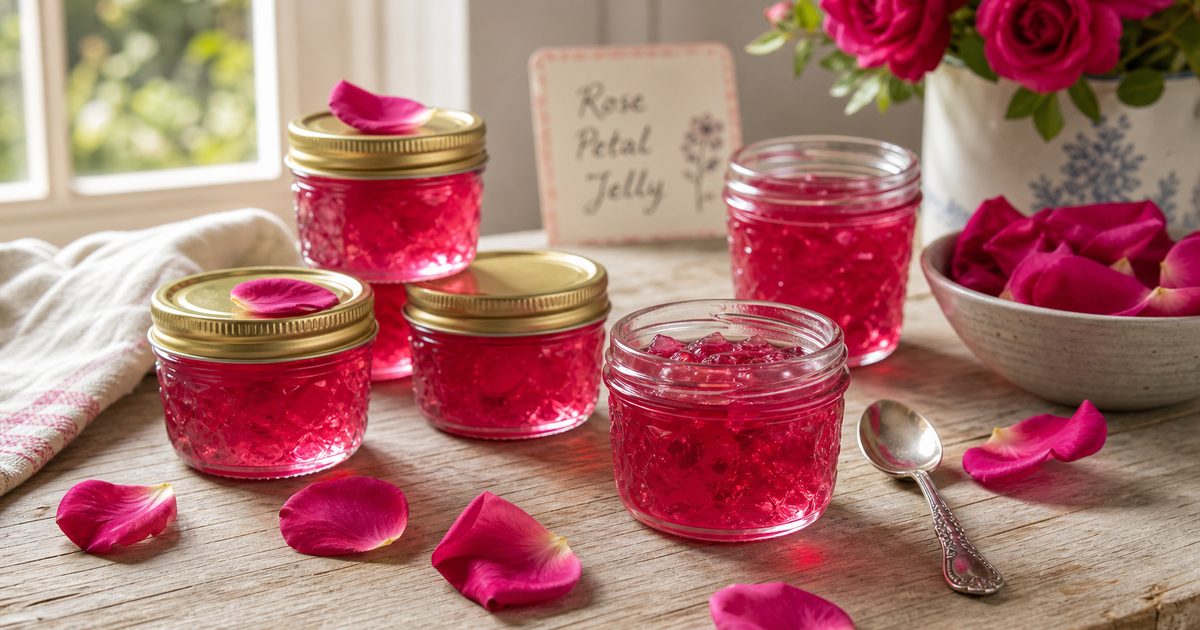
A spoonful of rose petal jelly tastes like spring caught in a jar. It’s delicate, lightly floral, and a little tart from the lemon juice. If you’ve ever wondered how to make rose petal jelly at home, the good news is that the method is simple. The key is using fragrant, unsprayed roses and paying attention during the short boiling stage.
This preserve starts with a strong rose infusion, then gets cooked with lemon juice, powdered pectin, and sugar until it reaches a glossy set. The color often shifts into a bright pink, especially when you use dark pink or red petals. Spread rose petal jelly on toast, spoon it onto scones, or serve it with soft cheese for a floral touch.
Prep time is about 30 minutes, plus steeping and cooling time. Cook time is 10 to 15 minutes. Total time runs 1 to 2 hours, depending on how long you steep the petals and whether you process the jars for shelf storage. This batch makes 5 to 6 half-pint jars, about 5 cups.
Rose petal jelly ingredients
A short ingredient list leaves nowhere to hide, so each item matters.
- 4 cups fresh, unsprayed rose petals, from fragrant dark pink or red roses, white bitter ends removed
- 4 cups (946 ml) water
- 1/4 cup (59 ml) fresh lemon juice
- 1 packet (1.75 oz / 49 g) powdered fruit pectin
- 4 cups (800 g) white granulated sugar
- Optional: 1/2 teaspoon butter, to reduce foaming
This recipe is naturally free of gluten, eggs, nuts, soy, and shellfish. It is also dairy-free unless you add the optional butter.
Choosing roses for rose petal jelly
The roses matter more than anything else here. Use only fresh, edible roses that have not been sprayed with pesticides or other chemicals. Garden roses are often a better choice than florist roses, since florist flowers are usually treated and are not meant for eating.
Fragrance is your best guide. If the petals smell faint in the bowl, the finished jelly will taste faint in the jar. Dark pink and red roses usually give the prettiest color. Pale petals can still work, but the jelly may turn golden, tan, or muted pink instead of bright rose.
Take a few extra minutes to trim the white base from each petal. That pale section tastes bitter and can muddy the clean floral flavor.
How to make rose petal jelly
Prepare the petals
Rinse the rose petals gently under cool water. Drain well. Pinch or snip off the white base from each petal and discard it.
This is fussy but worth it. Cleanly trimmed petals give the jelly a softer, less bitter finish.
Make the rose infusion
Put the prepared petals in a heatproof bowl or large measuring jug. Pour 4 cups (946 ml) boiling water over them. Press the petals down so they stay submerged.
Let them steep for 10 to 15 minutes for a lighter infusion, or up to 1 hour for deeper color and stronger aroma. The liquid should smell floral and take on some of the petals’ color.
Strain and measure
Pour the rose tea through a fine-mesh strainer into a large saucepan or jam pot. Press gently on the petals to release the liquid, then discard the petals.
Measure the strained liquid. You want 4 cups (946 ml). If you are a little short, add enough water to bring it back to 4 cups.
Add lemon juice and pectin
Stir the lemon juice into the rose liquid. Whisk in the powdered pectin until it dissolves fully.
Lemon juice does several jobs here. It sharpens the flavor, helps the color stay bright, supports the pectin, and is important for safe water-bath canning.
Bring to the first boil
Set the pot over medium-high heat. Stir constantly and bring the mixture to a hard rolling boil. That means the boil does not stop when you stir.
Boil for 1 full minute.
Add the sugar
Pour in all the sugar at once. Stir until it dissolves. If you are using the butter, add it now to help reduce foam on the surface.
Boil again
Bring the mixture back to a hard rolling boil. Boil hard for 1 minute.
Some cooks like to check for 220°F (105°C) on a candy thermometer, but with powdered pectin, the timed boil is the usual method. Don’t keep it boiling longer than needed. Too much cooking can flatten the floral flavor and dull the color.
Fill the jars
Take the pot off the heat. Skim off any foam. Ladle the hot jelly into prepared, sterilized canning jars, leaving 1/4 inch (6 mm) headspace.
Wipe the jar rims clean. Apply the lids and screw bands. Process the jars in a boiling water bath for 10 minutes, adjusting for altitude if needed.
Cool and seal
Lift the jars out carefully and place them upright on a towel. Let them cool undisturbed for 12 to 24 hours. Once fully cool, check that the lids have sealed.
If a jar does not seal, refrigerate it and use it first.
Tips for the best rose petal jelly
A few small choices make a big difference.
Use roses with a strong scent. This sounds obvious, but it is the easiest way to avoid bland jelly.
Measure the lemon juice carefully. Too little can affect flavor, color, and set. For canning, it also matters for acidity.
Watch the boil closely. Once the pectin mixture reaches a full rolling boil, timing matters. Start counting only when the whole surface is boiling hard.
Skim foam if you want a clearer finish. The jelly will still taste fine with a little foam, but the jars look prettier without it.
If you’re searching for a homemade rose jelly recipe that keeps its color, dark petals and fresh lemon juice give you the best chance.
Variations and substitutions for rose petal jelly
There’s some room to change the flavor, but be careful with the sugar and pectin balance.
For a stronger floral note, stir in 1 tablespoon rose water. Add it after cooking, just before filling the jars, so the aroma stays fresh.
If you want a more decorative look, you can leave in a few finely chopped petals. Keep the amount modest so the texture stays jelly-like rather than turning stringy.
A lower-sugar version can work, but only if you switch to a low-sugar pectin such as Sure-Jell pink box or Pomona’s Universal Pectin. In that case, the sugar may be reduced to about 1.75 to 2.5 cups (350 to 500 g), following the pectin manufacturer’s directions. Do not cut the sugar in this recipe unless you also change the pectin, or the set may fail.
People sometimes look for rose petal jam, but this recipe is a true jelly since the petals are strained out before cooking.
Storage and canning safety
Properly processed and sealed jars can be stored in a cool, dark place for up to 1 year. Once opened, keep the jar in the refrigerator and use it within 3 weeks.
You can also freeze this preserve in freezer-safe jars for up to 6 months. Leave headspace so the jelly has room to expand.
Because this recipe is canned in a water bath, the lemon juice is not optional for shelf-stable jars. It helps keep the acidity in a safe range. Always use clean jars, new lids if required by the brand, and follow safe home-canning practices.
This recipe contains no meat or eggs, so there are no internal temperature concerns. The main food-safety issue is using only unsprayed edible roses and processing the jars correctly if you want pantry storage.
Ways to serve rose petal jelly
This floral preserve shines in small amounts.
Spread it on toast, English muffins, biscuits, or warm scones. Pair it with cream cheese, goat cheese, or brie. Spoon a little into plain yogurt, or use it to glaze a simple cake. It also makes a lovely addition to a tea tray.
If you enjoy old-fashioned preserves or are curious about edible flower recipes, this is one of the prettiest places to start.
Rose petal jelly FAQ
What kind of roses should I use for rose petal jelly?
Use fragrant, unsprayed, edible roses. Dark pink or red petals usually give the best color and the strongest flavor.
Can I use florist roses?
No. Florist roses are usually treated with pesticides or preservatives and are not safe to eat.
Why is lemon juice important in rose petal jelly?
It balances the sweetness, helps the pectin set, brightens the color, and supports safe water-bath canning.
Why do I need to remove the white base of the petals?
That white section can taste bitter. Trimming it off gives the jelly a cleaner floral flavor.
How do I know if my rose petal jelly will set?
Use the full amount of pectin, sugar, and lemon juice, then boil exactly as directed. A hard rolling boil for the stated time is the main cue. Some cooks also check for 220°F (105°C).